
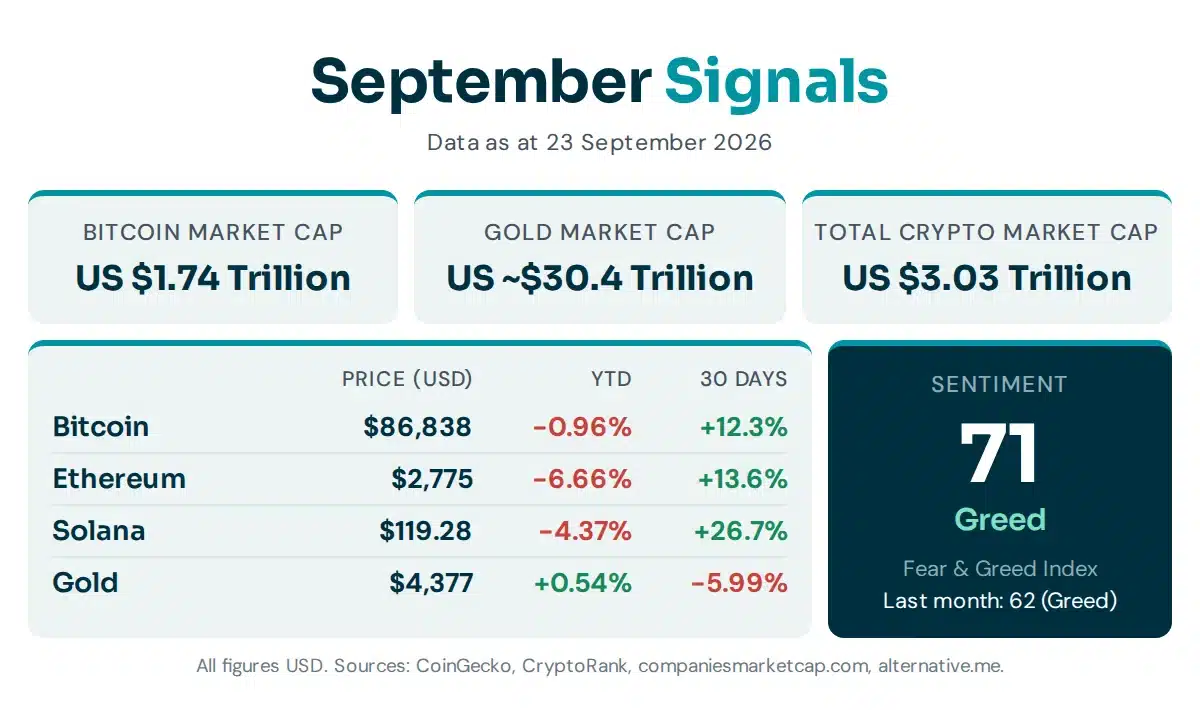
🗒️ Market update
Strength in the Face Of Adversity
On September 15, the US Senate blocked the Clarity Act 49-50, the most heavily lobbied piece of crypto legislation in history, eleven votes short of even getting a debate. The following morning, the Federal Reserve hiked rates 25 basis points to 3.75%-4.00%, and signalled at least one more increase on the horizon. Two of the most feared outcomes for crypto markets, landing in the same week.
Instead of selling off the market barely moved, instead it looked forward to an SEC or CFTC anouncement. Bad news is not landing, giving more credence our base case view the bear market is over and we are early stages of a bull market.
Clarity Act Is Dead. No One Told the SEC or CFTC.
The failure of the Clarity Act might be the most instructive event in crypto regulation since the Gensler era ended. The bill’s collapse, killed partly by ethics concerns and a hyper partisan stance before the midterms.
Within 48 hours, both agencies announced they were done waiting for Congress.
The SEC had already fired its opening shot on August 18 with the proposed “Regulation Crypto Assets” its first formal crypto-specific rulemaking and now in a 60-day public comment period. The proposal has three substantive components worth understanding:
-
First, two new offering exemptions. Projects can raise up to $5 million over four years, or up to $75 million per year, under disclosure-light frameworks modelled on existing small-company exemptions.
-
Second, an investment contract safe harbour. If a project can certify to the SEC that it has stepped back from essential managerial control, that the network is genuinely decentralised, the SEC will no longer deem its token a security subject to an investment contract.
-
Third, and in our view most importantly the SEC introduced a five-year conditional exemption specifically for tokenised-stock platforms. This is not incidental, it is the regulator explicitly building the runway for the product X launched Yesterday.
The CFTC moved on September 17, two days after the Clarity Act vote, submitting a proposal to the Office of Management and Budget to regulate crypto asset trading venues under existing Dodd-Frank authority. Rather than waiting for Congress to legislate its jurisdiction, the CFTC is asserting it. The proposal would bring crypto spot markets under a registration and reporting framework similar to what already governs futures markets. Alongside this, the CFTC issued no-action relief allowing crypto wallet interfaces and passive software providers to connect users to regulated derivatives markets without registering as introducing brokers, a meaningful unlock for DeFi protocols operating at the margin of legality.
Sitting above all of this is CFTC Chairman Michael Selig, who chose the week after the Clarity Act’s collapse to address a US Treasury markets conference hosted by the New York Federal Reserve. His message: the market needs to prepare for mass tokenisation. Over the next decade, Selig said, financial markets could undergo more change than in the past several decades, driven by tokenisation, on-chain finance, and 24/7 trading.
That is the chairman of the CFTC, speaking at a Federal Reserve event, telling the financial system to get ready. The market is being warned by its own regulators.
Tokenisation Doesn’t Wait for Permission Either
Before we get to X, a front end, a number that deserves to stand on its own at the back end: last week, Solana processed 208 million transactions, surpassing the NYSE’s weekly trade count for the first time in history. A blockchain did more transactions than the world’s largest stock exchange. Solana runs 24 hours a day, 7 days a week, with no opening bell and no settlement delay. The NYSE does not.
This is not a crypto statistic. This is a market structure statistic. The settlement layer is moving and it is happening faster than most realise.
The most quietly significant development of September happened not in Washington but in San Francisco. On September 15, X (formerly Twitter) launched its Cashtag Partner Programme — a feature that adds a Trade button to supported stock, ETF, and crypto tickers across its timeline. Tap any ticker symbol, see a live price chart and related posts, and execute a trade directly through Coinbase, Gemini, Kraken, Interactive Brokers or Moomoo.
Three hundred million people now have a trade button next to every financial news story they read.
Tokenised stocks globally exceeded $5.7 billion in quarterly trading volume in Q2. The Nasdaq’s proposal for 23-hour trading is designed specifically to accommodate the growing segment of tokenised securities that never sleep. The DTCC’s pilot for blockchain settlement of traditional equities went live in July. Each of these individually looks incremental. Together, they describe a financial system that is being rebuilt on programmable rails, and the timeline is 2027 at the outside, not 2030.
What’s Working Right Now
NEAR Protocol (Month to date +125%) was the month’s most compelling narrative play. The chart below tells the story better than any summary: NEAR Intents TVL hit $223.6 million as of September 21, $113.2 million confidential and $110.3 million public, with the exponential ramp only beginning in June. More remarkable than the absolute number is what just happened structurally: confidential TVL has crossed public TVL for the first time. More value on NEAR’s network is now moving through privacy-preserving channels than through transparent ones. That’s not a product feature. That’s a market expressing a preference. The [email protected] incentive programme rewarded early participants as the $70 million milestone was crossed in mid-September, sending the token up 15% in a single session. But the chart above is why we own it, that’s a network in the early stages of a genuine adoption curve, not a bounce.
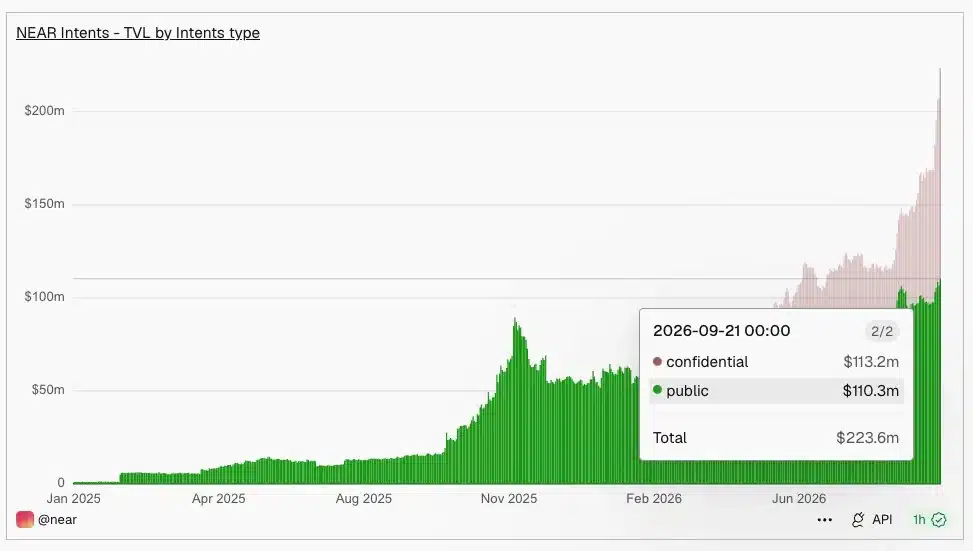
*Near Intents – Dune Analytics
Zcash (ZEC) (MTD +80%) has now been in the top 10 by market cap for over a month, it entered in August and has stayed there, trading north of $1,500 this week. The thesis we outlined in our August update is playing out: as the debasement trade reasserts itself and financial privacy becomes a more visible policy conversation, ZEC is being re-rated as a serious protocol rather than a fringe asset. It has a decade of cryptographic research behind it. Its staying power in the top 10 is meaningful validation.
Uniswap (UNI) (MTC +82%) continued its run from July, and the spot volume chart above explains the structural case. Over the past twelve months, Uniswap has commanded between 30% and 50% of all DEX spot volume, consistently, through the entire bear market, across every rotation between Solana and Ethereum ecosystems, and despite the emergence of a dozen serious competitors. That is a moat. September’s notable observation is that Uniswap’s share has held even as total market volume has recovered, it’s not just retaining share in a shrinking market, it’s holding share in a growing one. The SEC’s proposed safe harbour for protocol tokens, which allows tokens to shed their security classification as decentralisation increases, directly enables Uniswap to formalise value-accrual to UNI holders in a way that has been legally fraught since 2023. The regulatory unlock and the volume dominance are converging. UNI is the obvious beneficiary (Red below).
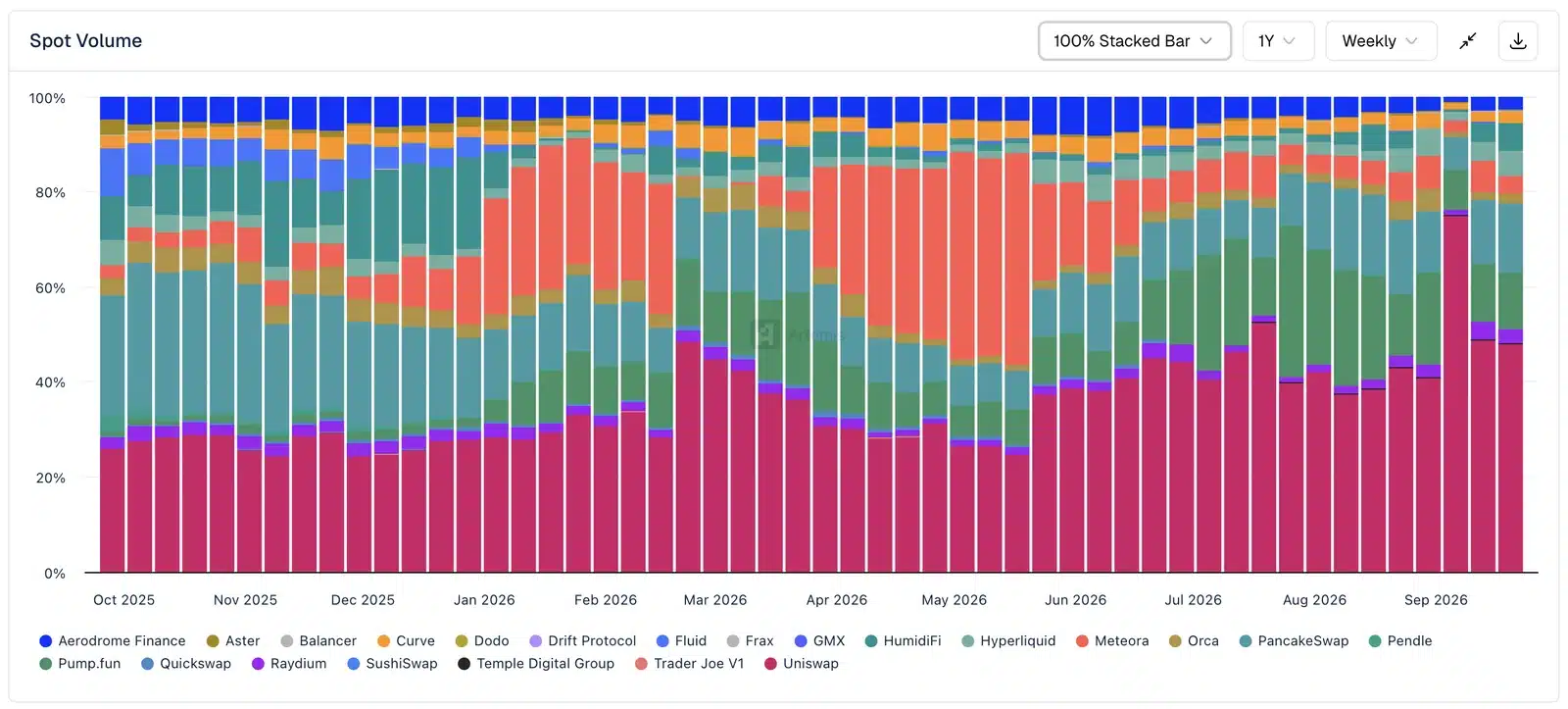
* Artemis Spot Dex Volume
On Our Own Performance
We try not to spend much time on this because performance should speak for itself at year’s end. But since we are at the three-quarter mark, it is worth saying once clearly.
The MTC Digital Asset Fund is up +8% year-to-date in AUD. Bitcoin, measured in AUD, is down 8% over the same period (−1% in USD; the stronger Australian dollar accounts for the difference).
That 16-percentage-point gap is not luck. Bitcoin’s year has been one of the most event-driven and volatility-compressed periods in the asset class’s history, ETF outflows, MSTR selling pressure, exchange closures, BIP-110 miner drama, DAT sector stress, three geopolitical escalations, and a rate hiking cycle that caught almost every risk model off guard. In an environment like that, undiversified BTC exposure has cost investors significantly.
Our approach has been straightforward: diversify across a high-conviction set of assets with real fundamentals, weight toward protocols where adoption is measurable and not merely anticipated, and avoid the structural losers that bear markets always shake out. ZEC, NEAR, UNI, PUMP, HYPE, these were not theme trades. They were selections made on the basis of actual activity, actual revenue, actual user growth. The data was there. The positioning followed.
As we enter Q4 and the historical window for the next cycle to begin building momentum, we remain constructive. The bear market has been long and hard. The assets that came through it with users still building and fundamentals still compounding are the ones worth owning for what comes next. Bull markets typically last for 3 years, and that should be everyones base case. The stage is set for crypto to go from fringe, interesting tech to transformational tech that rewrites the financial system for the digital age.
If you’d like to learn more about the MTC Digital Asset Fund or the MTC Bitcoin and Gold Fund, reach out to myself or the team. The asymmetric opportunity gets stronger every day.
Get in touch to discuss how digital assets fit in your portfolio:
🗓️ Key dates to watch
-
24 Sept – Trump Xi Summit
-
2 Oct – Non Farm Payrolls / unemployment rate
-
6 Oct – ISM PMI
-
14 Oct – CPI
-
1/8/15 Oct – Treasury long dated buy backs at > $4Bn
💡 Why Merkle Tree Capital
Owning digital assets directly means wallets, exchanges, custody risk and tax headaches. Our actively managed wholesale funds give you diversified exposure to high-conviction digital assets, with institutional-grade custody and none of the admin.
Smart · Active, disciplined selection with staking yield to help offset fees
Secure · Institutional custody, full counterparty due diligence
Simple · No wallets, passwords or crypto admin
📩 Interested in learning more? Visit www.merkle.com.au or reply to this email to book a call.