
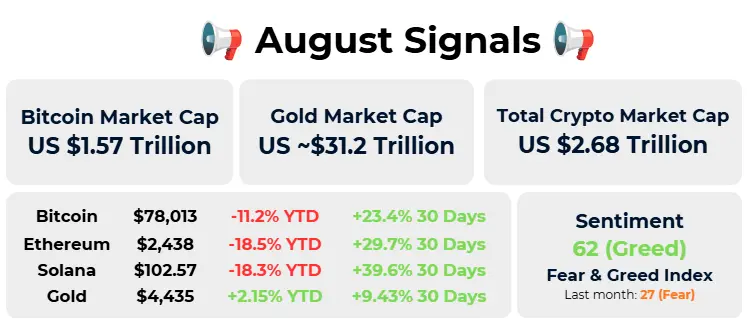
🗒️ Market update
Bitcoin went from consolidating in the low-$60,000s to briefly touching $81,400 in the space of a week. That's roughly a 27% weekly gain, one of the largest weekly advances in Bitcoin's history, and the biggest since early in the last bull cycle. Ether outran it on a percentage basis. Gold, made a move the previous week, caught a fresh bid. And Zcash led a broader privacy-coin rally that's become one of 2026's more persistent side stories.
None of it happened in isolation. Here's the chain of events, what's confirmed versus what's internet noise, and what it might actually mean.
Treasury, not crypto policy
The move didn't start with a crypto headline. It started with Treasury Secretary Scott Bessent doubling the pace of long-dated bond buybacks, from roughly $2 billion to at least $4 billion per operation, beginning in September, explicitly to support liquidity in the long end of the curve after yields had been grinding higher. Call it what you want, but the mechanics rhyme with yield curve control: the Treasury stepping in to cap borrowing costs as issuance keeps climbing. The dollar sold off on the news, and Bitcoin ripped through $68,000 straight after the buyback was announced.
That's the part of this rally that matters most for the medium-term thesis, and I'll come back to it.
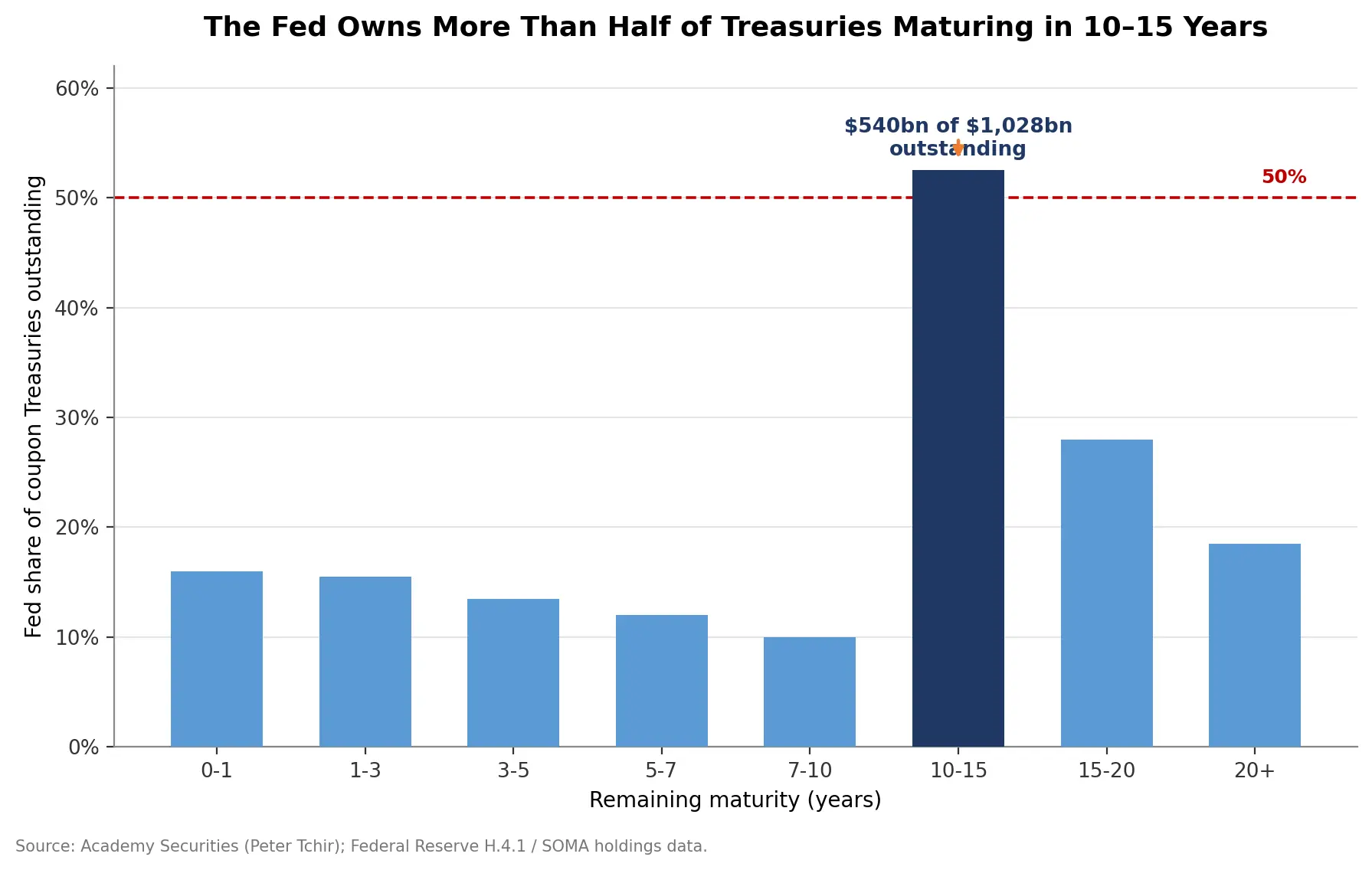
The "call it what you want" caveat is doing some work above, so it's worth being precise about why the YCC comparison isn't just rhetorical flourish. The Fed's own balance sheet is already heavily concentrated in exactly the maturity bucket the Treasury is now targeting with buybacks: the Fed owns more than half, $540 billion of the $1.028 trillion outstanding, of coupon Treasuries maturing in 10-15 years. Every other maturity bucket sits at 10-28% Fed ownership; the 10-15 year bucket is more than triple the next-highest.
That's not a coincidence of the Fed's QE-era purchasing pattern resolving itself, it's a single maturity segment where one buyer already dominates the float, and where the Treasury is now layering *additional* official-sector buying on top via the buyback program. Two arms of the same government, both leaning on the same slice of the curve, in the same direction, at the same time. If that's not yield curve control in substance, it's hard to say what the practical difference is.
White House reconfirms commitment to crypto
Later the same day, Trump hosted crypto executives alongside SEC Chair Paul Atkins and CFTC Chair Michael Selig. Two things came out of that meeting that moved price:
- Trump pushed Congress to pass "a fair version" of the CLARITY Act, the market-structure bill that would formally divide SEC/CFTC oversight of digital assets. It's genuinely stalled, a Senate cloture vote is pencilled in for mid-September. In a post on X, Brian Armstrong said Trump's message was clear: the White House was committed to passing the CLARITY Act. He also said Atkins and Selig were aligned and that "the entire industry is ready to get this across the finish line."
- Trump said Selig is "working very hard" to bring Hyperliquid (HYPE), the offshore perpetuals exchange that currently blocks US users, onshore under a compliant framework. HYPE spiked as much as 25% intraday on the line alone, despite zero detail on what that would actually require.
A genuine short squeeze
This is where the move stopped being a policy story and became a positioning story. The rally accelerated into the largest liquidation event of 2026, north of $3 billion wiped out from a Bitcoin futures open interest base of roughly $49 billion. That's the mechanical engine behind the back half of the move from $70,000 to near $80,000: forced buying, not fresh conviction.
How big was the move on a relative basis?
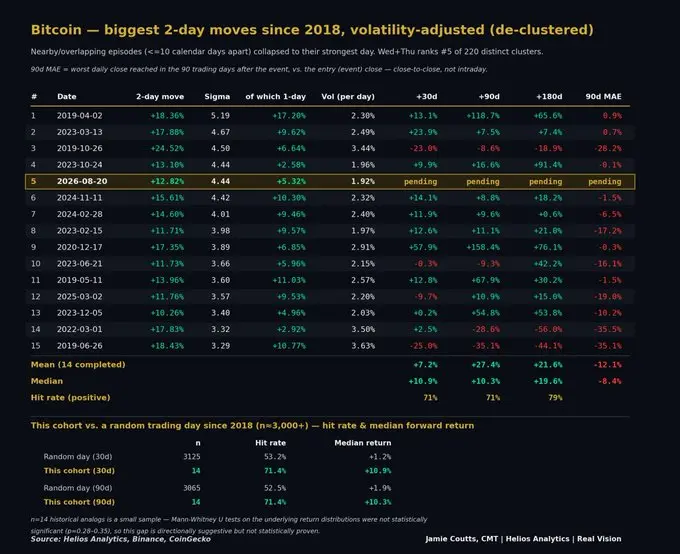
Raw percentage terms flatter almost every rally in a volatile asset. The more useful lens, courtesy of Jamie Coutts (CMT, Helios Analytics), is to volatility-adjust it. Bitcoin has been in a structural volatility downtrend for years, which means a given percentage move today represents a much larger statistical outlier than the same move would have five years ago.
On that basis, last week's two-day move ranks as the **fifth-largest since 2018**, a 4.4-sigma event. Only five episodes have topped it since 2018. Both the 2018 and 2019 major lows saw a volatility squeeze followed by a similarly outsized impulse move higher, and in both cases it marked a cycle inflection rather than a bounce within a downtrend.
The forward statistics back that framing, with the obvious caveat that 14 completed historical analogs is a small sample: Bitcoin has traded higher more than 70% of the time in the 30, 90 and 180 days following moves like this, against something closer to a coin flip for a random trading day. Median forward returns are also meaningfully higher than the random-day baseline. Directionally suggestive, not proof.
Debasement trade, round two
The part of this story I think matters most for a macro audience is how uniformly the "hard asset" trade traded together. Gold, already up sharply in 2026 on dollar weakness, Fed-independence concerns and record central-bank buying, caught a fresh bid on the same dollar-debasement logic driving Bitcoin. Total crypto market cap added more than $150 billion in a single session, crossing $2.45 trillion. And privacy coins, led by Zcash (+60% YTD), extended a run that's been one of standout niche trades of the year, as the same investors chasing non-sovereign, hard-supply assets rotate into ones that also can't be surveilled.
That's not a coincidence. It's the same trade wearing three different wrappers: a hedge against a Treasury that's now visibly leaning on markets to keep a lid on its own borrowing costs.
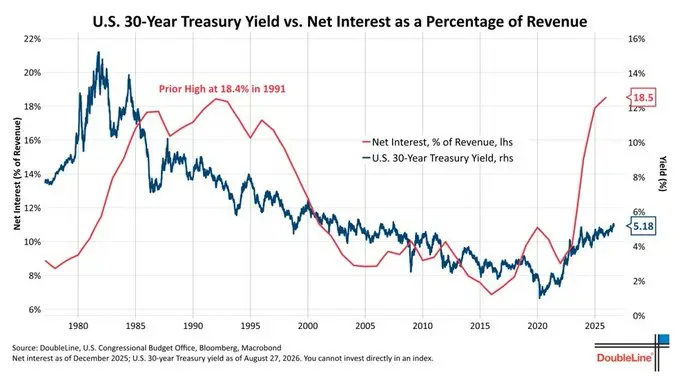
The debt is starting to matter again, net interest as a percent of revenue has breached the highs of the 1990s. Interests rate will be keep artificially low by and and all means available.
At Jackson Hole over the weekend, Warsh remained 'hawkish,' committed to the inflation target. Treasury will have to do the heavy lifting for now, but knowing the relationship and philosophy Bessent and Warsh share, it might not be long before they're working in concert rather than at cross purposes. With midterms in November and the Anthropic IPO mooted for early October, a hint of a dovish stance would go a long way toward keeping markets buoyant and letting the crypto resurgence take root — another leg higher to confirm an end to the bear market.

The smart money was already positioned
What makes last week's move harder to dismiss as pure momentum is that some of macro's most-watched names were leaning this way before the rally, not chasing it after the fact.
Stanley Druckenmiller's Duquesne Family Office disclosed roughly $88 million in new crypto-adjacent positions in its Q2 13F: a $64.7 million stake in Bitcoin miner Bitdeer, and a $23.1 million stake in Hyperliquid Strategies (PURR), a digital-asset-treasury vehicle that exists purely to accumulate and stake HYPE. The PURR position is small relative to Duquesne's book, but the signal matters more than the size, Citadel, Jane Street, BlackRock and State Street all built out similar HYPE-adjacent exposure over the same quarter, well before Trump's Hyperliquid comment sent the token spiking.
Ray Dalio spent the back half of the week making the debasement case as bluntly as he ever has. In a Friday LinkedIn post, timed to land right after Bessent's buyback announcement, the Bridgewater founder said the government's fiscal position looks close to an inflection point, floated a US debt crisis arriving in roughly three years, and told investors to go underweight bonds while holding 10-15% of a portfolio in gold plus "a bit" of Bitcoin. It's not a new allocation for Dalio (he's talked about a ~1-2% Bitcoin position before), but the timing and the framing, explicitly tying it to the Treasury's own intervention, is new.
Paul Tudor Jones' Tudor Investment added to its BlackRock spot Bitcoin ETF (IBIT) position in Q2, up 18.9% to 688,529 shares (~$22.9 million), the first quarter-on-quarter increase after a year of steady selling that had taken the position 91% below its late-2024 peak. He simultaneously cut his IBIT call options by 85%, which reads less like a leveraged momentum bet and more like a shift toward plain spot exposure. Worth the caveat that a 13F is a stale, quarter-old snapshot as of June 30 ,it tells you where conviction was building before this week's rally, not what any of these three did with it afterward.
None of these are single-handedly the reason Bitcoin ran from $63,000 to $81,000. But they're evidence the "debasement trade" framing isn't just a crypto-Twitter narrative bolted on after the fact, some of the most closely watched allocators in macro were already leaning into gold and Bitcoin, for overlapping reasons, ahead of the week that made the trade obvious to everyone else.
If you’d like to learn more about the MTC Digital Asset Fund or the MTC Bitcoin and Gold Fund, reach out to myself or the team. The asymmetric opportunity gets stronger every day.
Get in touch to discuss how digital assets fit in your portfolio:
www.merkle.com.au or [email protected]
🗓️ Key dates to watch
30 July - FOMC (40% odds of a hike is one of the more uncertain lead ins to an FOMC in years - Warsh’s no more guidance) + CORE PCE & GDP Adv Est
4 Aud - ISM PMI
5/7 Aug - JOLTS and Non Farm Payrolls (note jobs data looks to be less important under Warsh)
3-10 Aug - Senate to force a vote on the Clarity Act
💡 Why We Exist – Giving You Confidence in Crypto
Accessing digital assets is hard. From self-custody risks to tax complexity and misinformation, the hurdles are high. That’s why we built an actively managed unit trust to help investors confidently access the most promising digital assets — the ones we believe will underpin the future of the financial internet over the next 5–10 years.
Our investors gain exposure to a diversified portfolio of high-quality crypto assets — without needing to manage wallets, exchanges, or tax chaos. We aim to simplify the experience, reduce risk, maximise potential yield, and bring institutional-grade risk management to every investor.
🧠 SMART
Actively managed portfolio, aiming to enhance risk-adjusted returns
Disciplined asset selection, with a long-term, buy-and-hold bias
Yield from staking to help offset fees
Simple access — no wallets, passwords, or crypto admin required
🔒 SECURE
Institutional-grade custody with Coinbase Custody
Staking conducted in insured cold storage
Comprehensive counterparty due diligence
Assets remain fully segregated and secure
🪙 CRYPTO
Blockchain removes intermediaries, reducing cost and improving efficiency
Transparent and borderless financial infrastructure
Unlocking new use cases in payments, identity, infrastructure and beyond
📩 Interested in learning more? Visit www.merkle.com.au or reply to this email to book a call.