
🗒️ Market update
Activity Is Moving On-Chain, and Token Holders are Getting Paid
Markets are heading into the 3 November US midterms on the back foot, but history says the softness tends to come before the vote, not after it.
The MTC Digital Asset Fund rose more than 55% in Q3, driven by a strong recovery in DeFi. Regulation moved our way too. The SEC opened the door to trading tokenised US equities on-chain, and its staff signalled that token buybacks on genuinely decentralised protocols need not make those tokens securities. That gives DeFi protocols a clearer path to share revenue with token holders.
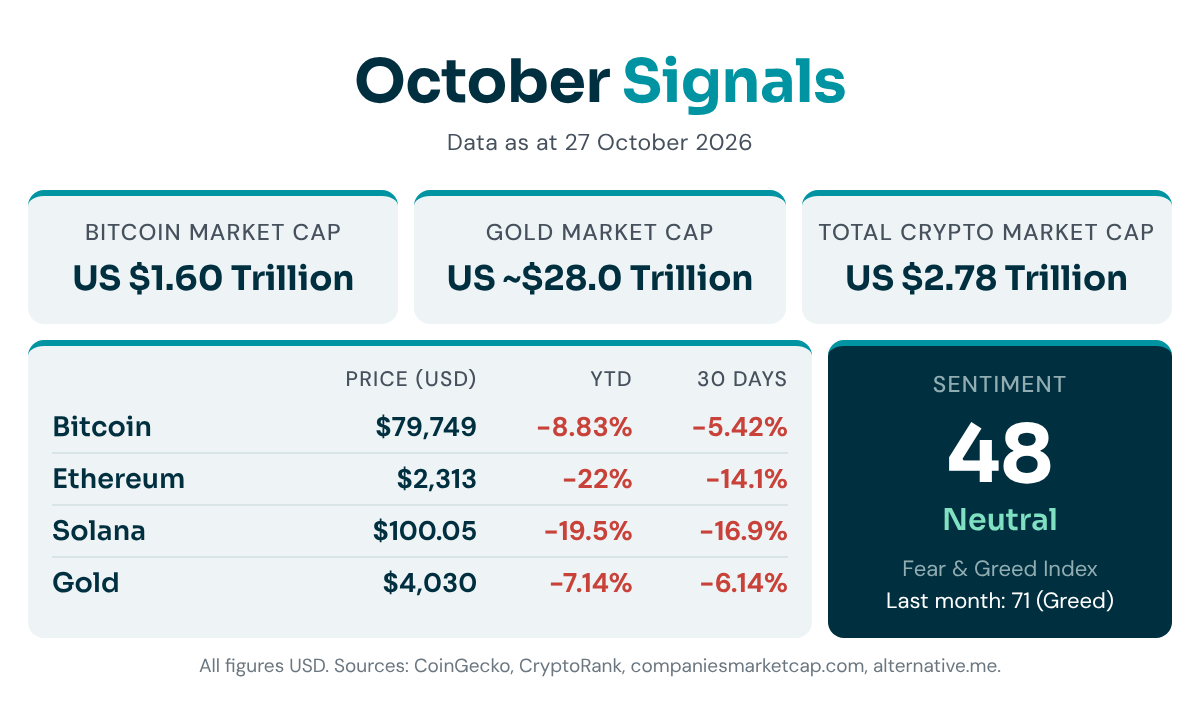
The last few weeks have been heavy. Hot September inflation (3.7% headline CPI) and a 10-year yield pushing above 5% have put the cost of the debt-funded AI build-out under the spotlight, and memory and chip names have led a tech sell-off. Stocks finished last week lower as AI spending worries met rising oil and Middle East tensions. Bitcoin has drifted back down to around $80K, .
This Month's message: underneath the soft prices, trading activity keeps moving on-chain, and DeFi venues, particularly spot DEXs and perpetual exchanges, are sharing more of what they earn with token holders. Then we look at what markets have typically done once the midterm noise clears.
1. Activity is moving on-chain
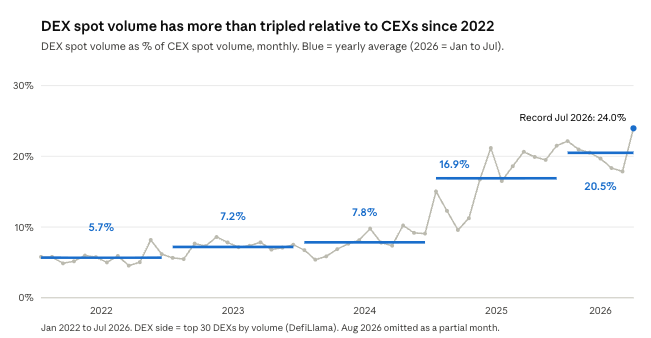
Even through a bear market, a growing share of crypto trading now happens on-chain. DEX spot volume averaged 5.7% of centralised-exchange volume in 2022 and under 8% through 2024. It jumped to 16.9% in 2025, has averaged 20.5% so far in 2026, and hit a record 24.0% in July (The Block Data).
Perps are following the same path. Hyperliquid, the largest on-chain perp venue, now holds 11.3% of open interest measured against the eight major centralised exchanges combined. Two years ago it was about 1%. The share peaked at 11.9% on 6 October and has held near that level through the recent sell-off.
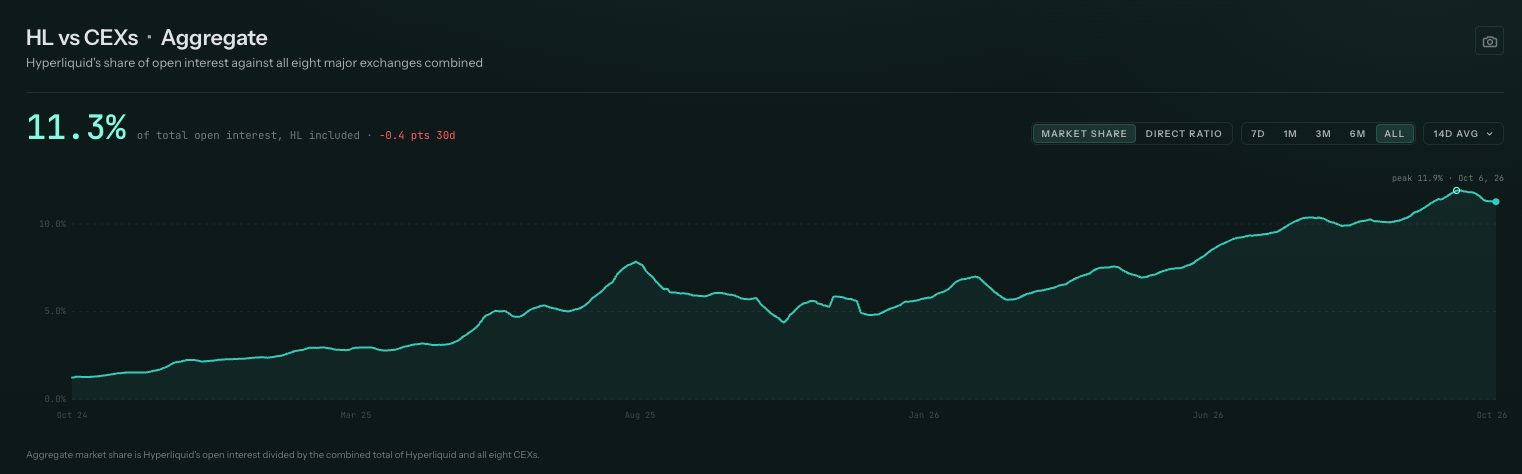
*Hyperliquid's open interest as a share of Hyperliquid plus eight major CEXs, 14-day average - hl.eco
Payward, the parent company of Kraken, announced its intention to be the first CFTC-regulated deployer on HIP-3* markets. Payward will use Hyperliquid as the infrastructure layer to deploy perpetual futures markets for US clients. Subject to regulatory approval, Bitnomial, Payward’s CFTC-regulated DCM and DCO, would act as the HIP-3* deployer: creating, owning, and administering the markets and clearing and settling the contracts.
Glassnode and Fasanara see the same trend on a broader measure that includes CME: Hyperliquid holds 7% of all Bitcoin futures open interest, while CME's share fell from about a third to 19%. On-chain perp venues also traded $635bn over the past 30 days, nearly three times the $223bn on spot DEXs, so perps are now the bigger on-chain market.
New assets are going on-chain first, too. Robinhood's chain, built around tokenised stocks, became the third-largest DEX chain within three months of launch, with $32.4bn of volume in the 30 days to 21 October. And ICE, owner of the NYSE, has filed with OKX to trade tokenised stocks through permissioned Uniswap v4 pools.
2. Venues are Sharing More Revenue
Trading venues are where DeFi's value accrual is happening. Over the past 30 days, perp exchanges, launchpads and DEXs paid about 94% of the holder revenue among DeFi's top payers on DefiLlama. That means buybacks, burns and distributions that reach token holders, not just fees earned.
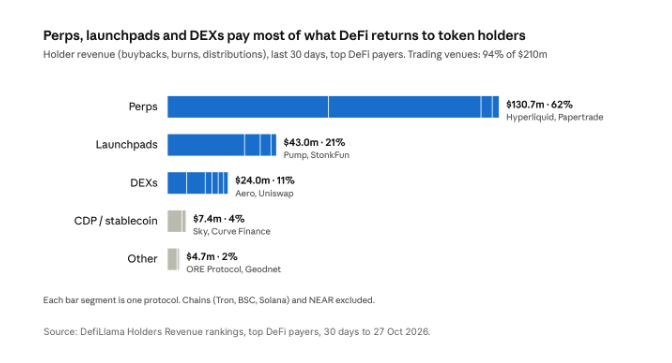
The wider trend points the same way. Across DeFi, the share of fees reaching token holders has risen from 7.1% in 2023 to 10.7% so far this year, even with sector fees running below 2025. And the trading venues punch far above their weight. Jamie Coutts Helios' research shows DEX tokens are 0.5% of the market cap but earn 19.4% of the fees ($6.5bn of $33.5bn).
Earning fees and sharing them are different things. The biggest fee earners in crypto are stablecoin issuers and lenders, and most of their income never reaches a token. The trading venues pass far more through:
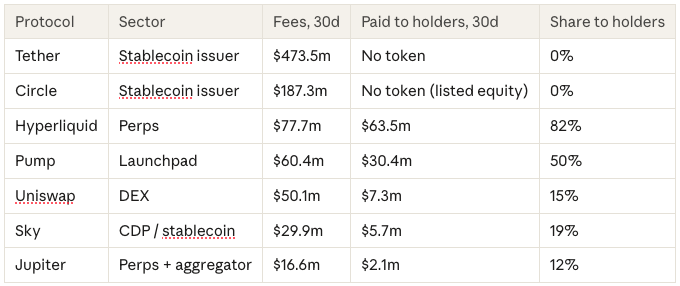
Aave and Lido are both top-10 fee earners ($40.5m and $34.9m) but don't appear among the top holder-revenue payers. The payout models also differ: Hyperliquid and Pump buy back their tokens, Uniswap's fee switch (live since December 2025) burns UNI for every holder, and Aero pays stakers who lock. Good protocols are updating their tokenomics for this new reality, Aave the latest to vote on a buy back mechanism directing a share of revenue to token appreciation.
3. What usually happens after the midterms
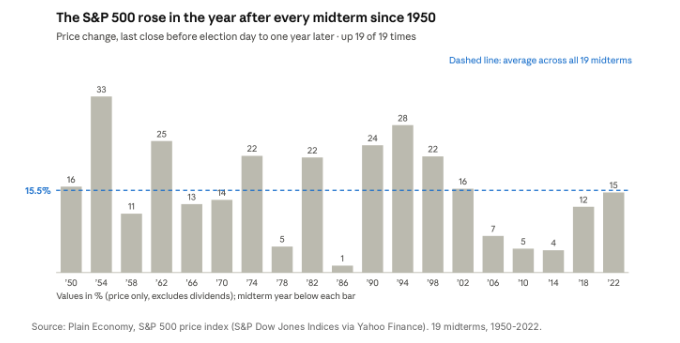
The pattern is weak before the vote, strong after it, in both stocks and crypto.
Equities. Since 1950 the S&P 500 has risen in the 12 months after every one of the 19 midterm elections, by 15.5% on average (Plain Economy). Over the longer record back to 1874, it has risen after 32 of 38 midterms, averaging 14% against 11% for any 12-month period (Motley Fool). The usual explanation is that uncertainty clears once the makeup of Congress is known. U.S. Bank found the outcome itself, which party wins, has little bearing (U.S. Bank).
Crypto. Bitcoin has only three midterms of history, so treat this as a pattern, not a rule. It finished higher 12 months after all three, the path, unsurprisingly, is not always a straight line:
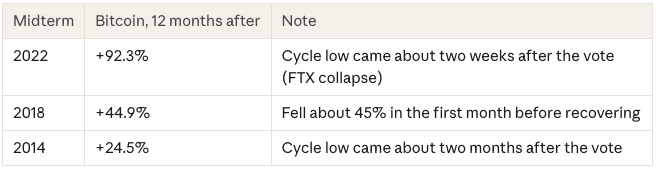
Sources: 12-month returns and the 2018 drop from CryptoQuant via DigitalToday; timing of lows from CoinCentral.
The bottom line
Prices are soft right now after a big move, but the activity underneath is not. Trading continues to move on-chain, DEX spot & perp venues are increasing market share, and a growing share of what those venues earn now reaches token holders. Usage plus real value accrual is the combination DeFi lacked last cycle, and it is showing up while prices are still depressed. Midterm history suggests the uncertainty tends to clear after the vote.
If you’d like to learn more about the MTC Digital Asset Fund or the MTC Bitcoin and Gold Fund, reach out to myself or the team. The asymmetric opportunity gets stronger every day.
🗓️ Key dates to watch
29 Oct - FOMC and Core PCE
3 Nov - Mid Terms and ISM PMI
4/6 Nov - Non Farm Payrolls / unemployment rate
10 Nov - CPI
💡 Why Merkle Tree Capital
Owning digital assets directly means wallets, exchanges, custody risk and tax headaches. Our actively managed wholesale funds give you diversified exposure to high-conviction digital assets, with institutional-grade custody and none of the admin.
Smart · Active, disciplined selection with staking yield to help offset fees
Secure · Institutional custody, full counterparty due diligence
Simple · No wallets, passwords or crypto admin
📩 Interested in learning more? Visit www.merkle.com.au or reply to this email to book a call.